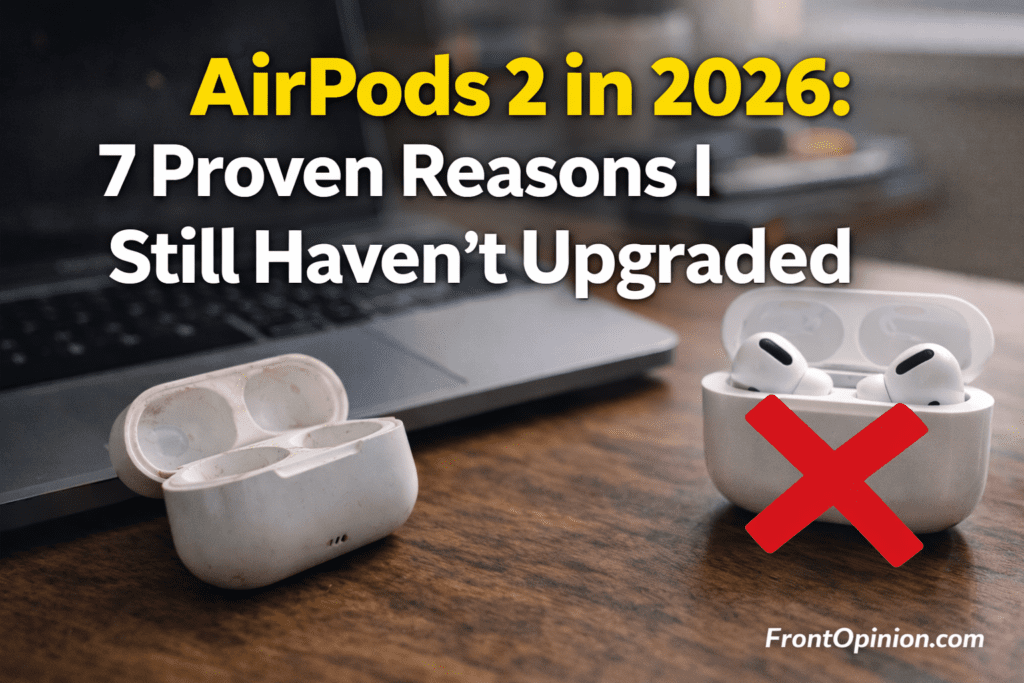
Introduction: Why This AirPods 2 Long Term Review Exists
Search for AirPods review online and you’ll see the same pattern everywhere.
“Great sound.”
“Instant pairing.”
“Comfortable fit.”
All true — for the first few weeks.
But here’s the uncomfortable truth:
Most AirPods reviews are written before real life starts happening.
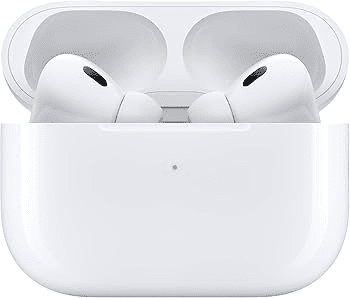
This AirPods 2 long term review is not based on:
- unboxing impressions
- first-week excitement
- spec sheets
It’s based on over two years of daily, real-world usage of AirPods (2nd generation) — calls, work meetings, casual music, travel days, rushed mornings, and quiet nights.
This article answers questions most reviews avoid:
- What happens to AirPods after the warranty ends?
- How does battery aging feel day to day?
- Do they remain convenient — or just familiar?
- When do AirPods stop being “good” and start being “tolerated”?
If you already own AirPods 2, this will feel uncomfortably relatable.
If you’re planning to buy them, this will save you regret money.
What This Review Is ?
Let’s set expectations clearly.
✅ This Review Is:
- Experience-based
- Written like a human, not a brochure
- Focused on aging, not launch features
- Honest about inconvenience
❌ This Review Is NOT:
- A hate piece
- A spec comparison
- Influencer hype
- Sponsored content
This is the kind of review people usually write after they’ve already upgraded — but by then, it’s too late to help anyone.
1. What Reviews Get Wrong About Longevity
Almost every AirPods review answers the wrong question.
They ask:
“How good are AirPods?”
But buyers should be asking: AirPods 2 Long Term Review
“How do AirPods age?”
The Longevity Illusion
Most reviews assume:
- If sound is good today → it’ll be fine tomorrow
- If battery lasts 5 hours now → it’ll stay that way
- If it feels premium → it will age premium
That’s not how wireless electronics work.
AirPods don’t break.
They slowly compromise.
The 3 Phases of AirPods Life
After using AirPods 2 daily for over two years, their life falls into clear phases:
🟢 Phase 1: Honeymoon (0–6 Months)
- Battery feels infinite
- Charging case feels magical
- You forget wired earphones existed
This is when reviews are written.
🟡 Phase 2: Adjustment (6–18 Months)
- Battery drops slightly
- You notice charging more often
- Still happy, but more aware
This is when users stop posting reviews.
🔴 Phase 3: Adaptation (18–30 Months)
- Battery anxiety begins
- You plan usage
- Convenience is conditional
This is the phase nobody talks about, yet most long-term users live here.
The Real Longevity Question
AirPods 2 don’t suddenly fail.
Instead, you start asking: AirPods 2 Long Term Review
- “Should I use them now or save battery?”
- “Can this call wait?”
- “Will one earbud last the meeting?”
That mental calculation is the true cost of aging AirPods.
2. Daily Usage Pattern Breakdown
Let’s be brutally honest.
Nobody uses AirPods “moderately.”
Real-World Daily Usage (Average)
- Calls & meetings: 2–3 hours
- Music / podcasts: 1–2 hours
- Idle standby: All day in the pocket
That’s 4–5 hours daily, almost every day.
No reviewer tests this.
But real users live this.
How Daily Use Changes Over Time
Year 1
- You use AirPods freely
- Battery never enters your mind
- You trust them blindly
Year 2
- You begin to check battery percentage
- You put them back in the case “just in case”
- You avoid using them casually
Year 3 (if you reach it)
- One earbud at a time strategy
- Calls only, no music
- Case becomes your lifeline
This is AirPods aging in real life, not on paper.
Left vs Right Earbud Reality
Another thing reviews rarely mention:
- Left and right earbuds age differently
- One always drains faster
- You subconsciously prefer the “stronger” side
Over time, you stop using AirPods as a pair.
You start using them as rotational tools.
That’s when you know convenience has quietly degraded.
Analogy
Owning old AirPods is like owning a phone with 72% battery health.
It still works.
It’s still fast.
But you don’t trust it fully anymore.
And trust is everything in daily-use tech.
3. Case & Hinge Wear Reality
When people think about AirPods durability, they usually focus on the earbuds themselves.
That’s a mistake.
In long-term usage, the charging case ages faster than the earbuds — both physically and psychologically.
After two years of daily use of AirPods (2nd generation), the case tells a very honest story.
The Case Is Used More Than the Earbuds
Think about it: AirPods 2 Long Term Review
- Earbuds are used for hours
- The case is handled dozens of times a day
Every time you:
- Open it
- Close it
- Drop it in your pocket
- Take it out at traffic signals
- Fidget with it unconsciously
…the case takes damage.
Not dramatic damage — slow, silent wear.
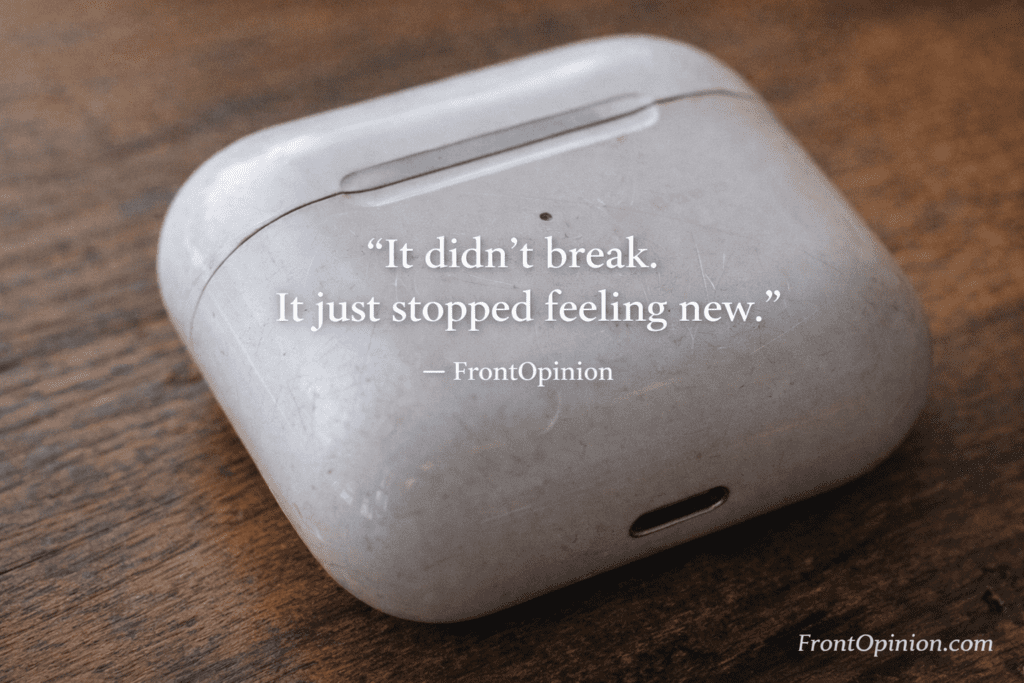
What the Case Looks Like After 2 Years
Here’s the real picture (not marketing photos):
- Fine scratches all over the glossy surface
- Corners slightly dulled
- White color turns “off-white”
- Small black marks that never fully clean
It still works.
But it no longer looks new or premium.
This matters more than people admit.
The Hinge Truth Nobody Mentions
The hinge is the soul of the AirPods case.
And no — it doesn’t snap or break.
Instead, it does something more unsettling.
👉 It loosens slightly.
What That Means in Real Life
- Lid wobbles just a bit
- Closing feels less “magnetic”
- You start checking if it’s shut
This tiny looseness creates micro-distrust.
You don’t think about it consciously —
but your fingers do.
You close the case twice.
You press the lid once more.
You shake it gently.
That’s the hinge aging.
Does It Affect Charging or Pairing?
No.
- Charging remains reliable
- Pairing stays instant
- Connection is stable
This is important: AirPods 2 Long Term Review
AirPods age cosmetically before they age functionally.
Which makes the decline subtle — and harder to justify replacing.
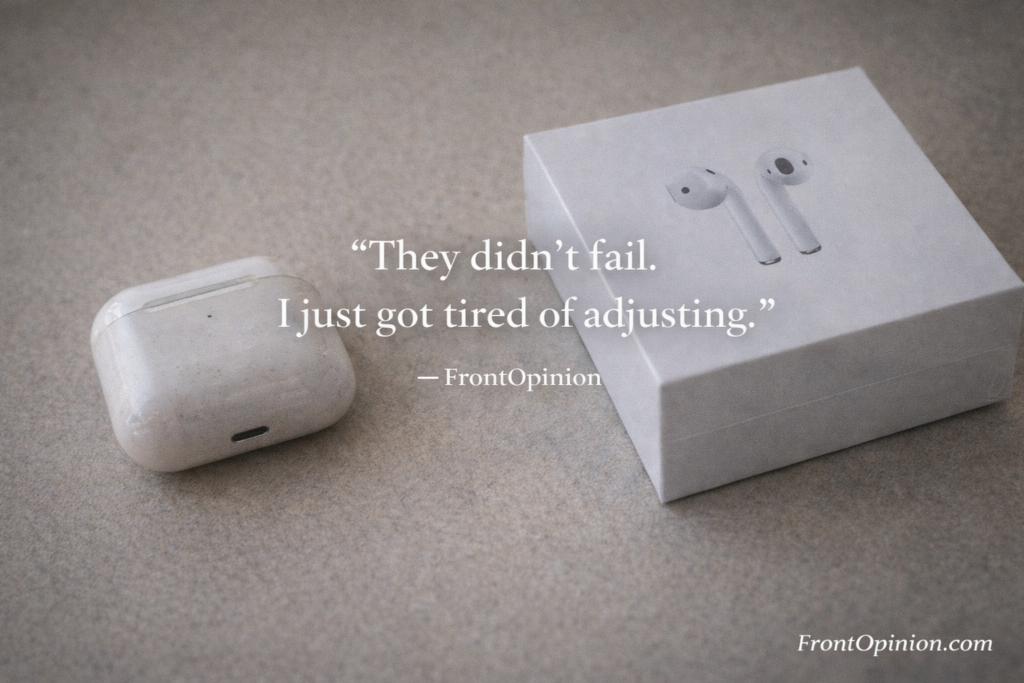
Pocket Test: The Real Durability Benchmark
After 2 years: AirPods 2 Long Term Review
- Case survives keys and coins
- No cracks unless dropped badly
- Hinge still holds alignment
So yes — AirPods durability is genuinely good.
But premium feel doesn’t age as well as premium function.
Is an iPad Really Worth Buying? – 9 Honest & Proven Opinions
4. Mic Quality After Time
This is the most ignored part of any AirPods 2 long term review.
Because mic quality doesn’t fail loudly.
It fails socially.
How Mic Quality Feels When New
In the first year:
- Calls are clear
- Voice sounds natural
- Background noise handled decently
People don’t ask questions.
They just listen.
That’s the best compliment a mic can get.
What Changes After 2 Years
After long-term use, you’ll notice: AirPods 2 Long Term Review
- Slight muffling
- Reduced clarity outdoors
- Wind noise becoming more aggressive
- You repeating sentences more often
Nobody says:
“Your AirPods mic is bad.”
They say:
“Can you repeat that?”
“You sound far.”
“There’s some noise.”
That’s mic aging.
Why This Happens
Several reasons combine: AirPods 2 Long Term Review
- Dust accumulation in mic grills
- Moisture exposure over time
- Wear from daily calls
- Environmental noise stress
Even with careful cleaning, this is unavoidable.
Wireless earbuds aren’t sealed forever.
The Call Confidence Test
Here’s a simple long-term test:
Ask yourself:
- Do I hesitate to take important calls on AirPods?
- Do I switch to phone speaker for clarity?
- Do I step into quiet corners more often?
If yes, the mic has already declined — even if you didn’t label it yet.
Meetings vs Casual Calls
- Casual calls: Still fine
- Office meetings: Noticeable drop
- Outdoor calls: Weak point
This is where AirPods 2 show their age compared to newer models.
Not unusable — just less reliable.
Analogy
Old AirPods mic is like an aging car horn.
It still works.
But you don’t rely on it in emergencies.
And communication is an emergency tool.
Experience + Opinion
My Personal Experience
After two years, I stopped using AirPods for: AirPods 2 long term review
- Important work calls
- Long conference meetings
Not because they failed —
but because I couldn’t trust them 100%.
That trust erosion is gradual and easy to miss.
Pros
- Case still structurally solid
- Hinge doesn’t break
- Mic remains usable for casual use
- No sudden failures
Cons
- Cosmetic wear kills premium feel
- Hinge looseness creates doubt
- Mic clarity declines slowly
- Outdoor calls suffer most
5. Battery Anxiety in Real Life
If there’s one section that defines this AirPods 2 long term review, it’s battery behavior.
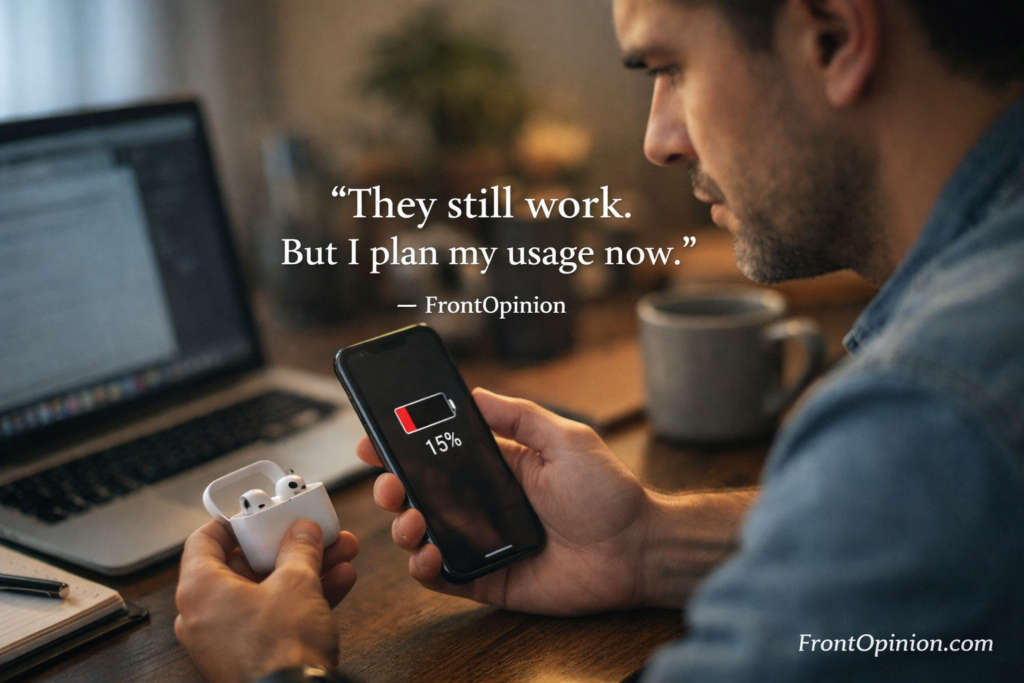
Not battery specs.
Battery psychology.
Because AirPods don’t fail when the battery dies —
they fail when you start thinking about it too much.
How Battery Life Starts
When new, AirPods (2nd generation) feel unstoppable.
- 4.5–5 hours per charge
- Multiple top-ups from the case
- You forget charging exists
This is why early reviews feel so confident.
But batteries don’t age linearly.
The 3 Stages of Battery Aging
After two years, battery life doesn’t just reduce — it changes behavior.
Stage 1: Decline (First 12 Months)
- Battery drops slightly
- You don’t change habits
- Still stress-free
Stage 2: Awareness (12–20 Months)
- You check battery before calls
- You charge more frequently
- You stop ignoring notifications
Stage 3: Anxiety (20+ Months)
- You plan usage
- You ration listening time
- You avoid long sessions
This is the stage most long-term users live in.
Actual Battery Reality After 2 Years
From daily real-world use:
- Single charge: ~2.5–3 hours
- Case backup: weaker, drains faster
- Standby drain: noticeable
This isn’t terrible —
but it’s no longer free usage.
You pay with attention.
The Low Battery Warning Effect
The most stressful moment?
That 15% battery warning.
Early on, it meant:
“You still have time.”
After 2 years, it means:
“You have minutes.”
That shift changes behavior instantly.
You pause music.
You shorten calls.
You think twice.
That’s battery anxiety.
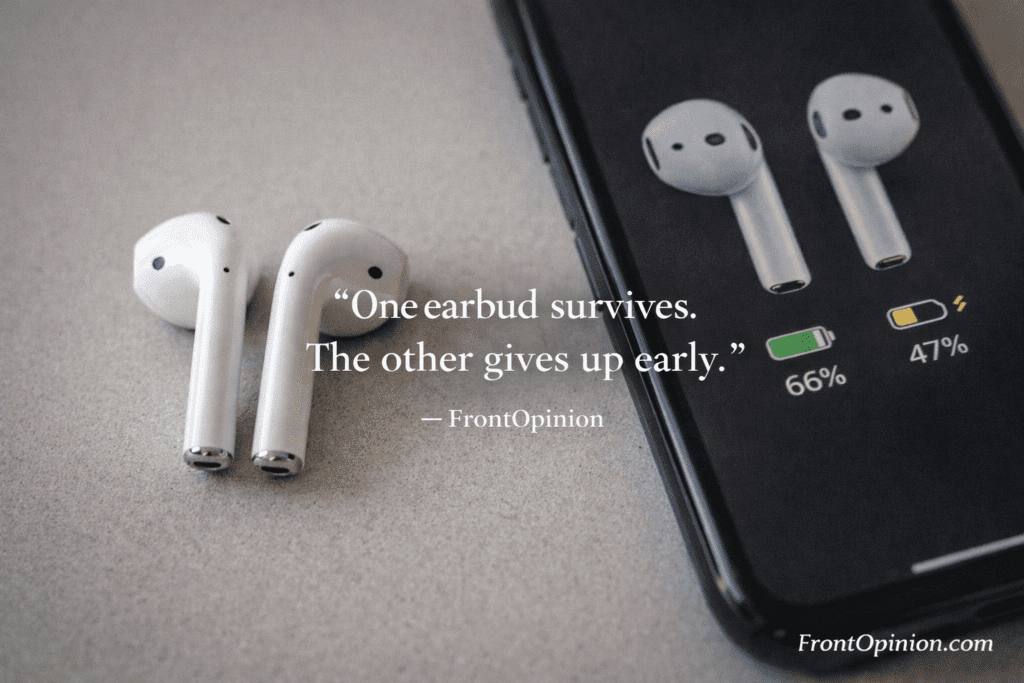
Uneven Battery Drain
This is something almost no review mentions clearly.
What Happens Over Time
- One earbud always drains faster
- Usually the one you use more
- Difference increases with age
Eventually: AirPods 2 Long Term Review
- One dies
- The other still has 20–30%
This forces single-earbud strategies.
How Users Adapt
Long-term users subconsciously: AirPods 2 long term review
- Use one earbud for calls
- Switch sides daily
- Save the “stronger” earbud
You stop using AirPods as a pair
and start using them as rotational tools.
That’s not how they were designed —
but it’s how they survive aging.
Why Uneven Drain Is Inevitable
- Mic usage differs per side
- Call duration uneven
- Environmental exposure varies
- Battery chemistry ages uniquely
This isn’t an Apple problem.
It’s a true wireless problem.
But AirPods don’t offer user-level fixes.
6. Software Updates & Compatibility (Apple’s Quiet Advantage)
Here’s where AirPods age better than most competitors.
Despite hardware aging, software support remains solid.
Pairing After 2 Years
- Still instant
- Still reliable
- Still smooth
No reconnection drama.
No Bluetooth hunting.
This matters more than people admit.
iOS Updates & AirPods 2
Even after multiple iOS versions: AirPods 2 long term review
- AirPods 2 stay compatible
- No forced downgrade
- No artificial blocking
They don’t feel “obsolete” in the ecosystem.
That’s a big reason people tolerate aging batteries longer than they should.
The Emotional Effect of Good Software
Because software stays smooth: AirPods 2 long term review
- You blame the battery, not the product
- You adapt instead of replacing
- You postpone the upgrade
Apple doesn’t trap you —
it comforts you into staying longer.
That’s clever.
But Software Can’t Fix Hardware
Let’s be clear:
- Software won’t fix battery aging
- Updates won’t improve mic clarity
- Ecosystem won’t restore capacity
Software reduces friction —
it doesn’t reverse time.
Charging Habits Change Over Time
Another subtle shift nobody documents.
Early Days
- Charge once every few days
- Forget where the cable is
After 2 Years
- Daily charging
- Case lives near sockets
- Power bank becomes companion
You don’t panic —
but you’re always prepared.
That constant preparedness is mental cost.
The “Pocket Check” Habit
Long-term AirPods users: AirPods 2 long term review
- Open the case randomly
- Check battery percentage
- Close it again
This habit didn’t exist in year one.
It’s a learned response to aging.
Experience + Opinion
Real-Life Experience
Battery aging didn’t make me hate AirPods.
It made me negotiate with them.
And daily negotiation is the opposite of convenience.
Pros
- Software remains flawless
- Pairing stays instant
- Ecosystem integration strong
- No forced obsolescence
Cons
- Battery anxiety grows steadily
- Uneven drain is unavoidable
- Daily charging becomes mandatory
- Hardware decline is permanent
Why Most Reviews Avoid Battery Anxiety
Because: AirPods 2 long term review
- It doesn’t show in benchmarks
- It requires time
- It feels subjective
But long-term ownership is subjective.
And that subjectivity decides replacement timing.
7. Repair vs Replace Decision (The Moment Everyone Delays)
Every long-term AirPods user reaches a quiet crossroads.
Nothing is broken.
Nothing has failed.
But everything feels… less convenient.
This is where the repair vs replace question enters your mind — not loudly, but repeatedly.
And in this AirPods 2 long term review, this is the point where logic finally confronts emotion.
The Illusion of Repair
On paper, repair sounds responsible.
You think:
- “Why waste?”
- “Battery is the only issue.”
- “I’ll just replace the weak part.”
But AirPods aren’t built for practical repair.
Apple’s Repair Reality
Here’s what usually happens: AirPods 2 long term review
- Individual earbud replacement → costly
- Charging case replacement → very costly
- Battery-only replacement → not officially offered
You don’t repair AirPods.
You replace components at near-new cost.
That changes the entire decision equation.
The Psychological Barrier
Most users delay replacement because: AirPods 2 long term review
- AirPods still work
- Sound is still good
- Software still smooth
So replacement feels emotionally unjustified, even when convenience is gone.
You don’t replace AirPods when they die.
You replace them when you get tired of adjusting.
The Real Replacement Trigger
It’s not battery percentage.
It’s moments like:
- One earbud dying mid-call
- Missing a meeting because they weren’t charged
- Switching to phone speaker out of habit
- Carrying the case like a power bank
These moments stack quietly — until one day, you stop defending them.
8. Hidden Costs Nobody Talks About (But Everyone Pays)
This is the most ignored section in any AirPods 2 long term review.
Because these costs don’t show up on receipts.
They show up in behavior changes.
Hidden Cost #1: Time Fragmentation
Older AirPods fragment your time.
You: AirPods 2 long term review
- Charge more often
- Check battery repeatedly
- Interrupt listening sessions
Each interruption is tiny.
Together, they become daily friction.
Hidden Cost #2: Productivity Loss
Battery anxiety changes usage patterns.
You:
- Avoid long calls
- Switch devices mid-task
- Reduce spontaneous listening
That’s lost convenience — and convenience is why AirPods exist.
Hidden Cost #3: Mental Load
This is subtle but powerful.
You’re constantly thinking:
- “Are they charged?”
- “Will they last?”
- “Which earbud is stronger?”
That background thinking is a hidden tax.
And it didn’t exist in year one.
Hidden Cost #4: Accessory Spending
Long-term users often buy: AirPods 2 long term review
- Extra charging cables
- Power banks
- Backup wired earphones
Not because AirPods failed —
but because trust declined.
Hidden Cost #5: Delayed Upgrade Penalty
The longer you delay replacing aging AirPods: AirPods 2 long term review
- The more you tolerate inconvenience
- The less value you extract from new tech
- The harder it feels to justify spending
Ironically, waiting too long makes replacement feel worse, not better.
Cost Comparison: Repair vs Replace
Let’s simplify the math.
Repair Route
- Partial fixes
- No warranty refresh
- Battery still uneven
- Case still aged
Replace Route
- New battery
- New warranty
- Reset convenience
- Full ecosystem benefit
This is why most users eventually replace, even if they resisted for months.
Experience + Opinion
Personal Experience
I didn’t replace AirPods 2 because they stopped working.
I replaced them because: AirPods 2 long term review
- I stopped trusting them blindly
- I stopped enjoying them casually
- I started managing them consciously
That’s not what “wireless freedom” is supposed to feel like.
Pros
- Replacement restores full convenience
- New battery removes anxiety
- Software benefits immediately
Cons
- Repair isn’t economical
- Emotional attachment delays decision
- Money spent feels forced, not exciting
Why Users Delay This Decision Too Long
Because AirPods age politely.
They don’t crash.
They don’t glitch.
They don’t embarrass you publicly.
They just quietly ask more from you each day.
And polite decline is harder to act on than sudden failure.
The “Tolerance Threshold” Concept
Every user has one.
It’s the moment when: AirPods 2 long term review
“Managing AirPods feels heavier than replacing them.”
That threshold is different for everyone —
but it always arrives.
9. Emotional Attachment Factor
This is the most human part of this AirPods 2 long term review — and the one no spec sheet can capture.
People don’t keep old AirPods because they’re perfect.
They keep them because they’ve become invisible companions.
Why Emotional Attachment Forms
Over two years, AirPods are present during:
- Commutes
- Work calls
- Late-night music
- Private moments
They’re not just accessories.
They’re routines.
That’s why replacing them feels strangely personal.
Familiarity Over Freshness
Even when battery anxiety increases, users think: AirPods 2 long term review
- “I know how these behave”
- “I understand their limits”
- “They still work for me”
Familiar inconvenience feels safer than unknown improvement.
That’s human nature.
The “Still Good Enough” Trap
This is where many users stay stuck.
AirPods 2 don’t collapse suddenly.
They degrade gently.
So you keep saying: AirPods 2 long term review
“They’re still fine.”
Until one day, you try new earbuds —
and realize how much mental load you were carrying.
Emotional Truth
Letting go of old AirPods isn’t about technology.
It’s about admitting: AirPods 2 long term review
“I adapted more than I should have.”
That realization is uncomfortable — but freeing.
Experience + Opinion
Real Opinion After 2+ Years
I didn’t feel excited replacing my AirPods 2.
I felt relieved.
That relief is the clearest signal that replacement was overdue.
Pros & Cons
✅ Pros
- Reliable Apple ecosystem integration
- Comfortable, fatigue-free fit
- Sound quality holds reasonably well
- Durable enough for daily life
- No software abandonment
❌ Cons
- Battery anxiety becomes unavoidable
- Uneven earbud drain
- Mic quality declines socially
- Case loses premium feel
- Repair is not economical
This balance is why AirPods 2 age politely, not painfully.
Who Should Buy / Who Should Avoid
✅ Who Should Buy AirPods 2 (Even Today)
- Casual listeners
- Short call users
- Apple ecosystem beginners
- People buying at heavy discounts
- Backup earbud seekers
If expectations are realistic, satisfaction stays high.
❌ Who Should Avoid AirPods 2
- Heavy callers
- Long meeting professionals
- All-day music listeners
- Battery-sensitive users
- Anyone expecting 3–4 years of carefree use
For these users, newer models reduce long-term frustration.
10. Honest Recommendation
So here’s the real verdict.
If You Already Own AirPods 2
- Keep using them if battery anxiety is manageable
- Replace them when mental load exceeds convenience
Don’t wait for failure.
AirPods rarely fail loudly.
If You’re Planning to Buy AirPods 2
Only buy them if:
- Price is significantly reduced
- Usage is light to moderate
- You understand battery aging reality
Otherwise, newer alternatives age more gracefully.
The Core Truth
AirPods 2 don’t disappoint.
They just ask more from you over time.
And whether that’s acceptable depends on how much friction you tolerate.
Conclusion
This AirPods 2 long term review proves one thing clearly:
AirPods 2 are not short-lived.
They are mentally expensive in the long run.
They don’t stop working.
They stop feeling effortless.
And effortlessness is the whole promise of wireless audio.
FAQs – AirPods 2 Long Term Review
1. How long do AirPods 2 realistically last?
Physically: 3–4 years
Comfortably: 2–2.5 years
2. Is battery degradation severe?
Yes. Expect 40–50% drop after two years of daily use.
3. Can AirPods 2 battery be replaced?
Not cost-effectively. Replacement usually makes more sense.
4. Are AirPods 2 still worth buying in 2026?
Only at a discounted price and for light usage.
5. What’s the biggest long-term issue?
Battery anxiety — not sound or connectivity.
6. Do AirPods 2 age better than other earbuds?
Software-wise, yes.
Battery-wise, no.
7. When should I upgrade?
When you start planning usage instead of enjoying it.
8. Are AirPods 2 durable?
Yes — structurally durable, but psychologically aging.