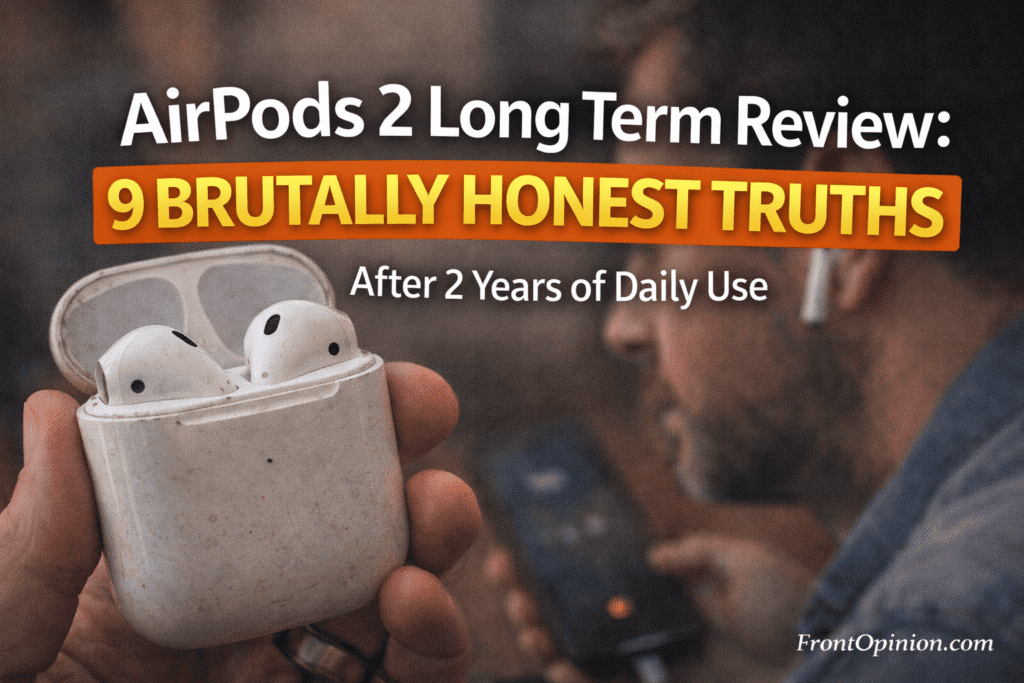
Introduction: Why Using Old Tech in 2026 Feels “Wrong”
Using AirPods 2 in 2026 feels almost… embarrassing.
Not because they don’t work.
Not because they sound terrible.
But because the internet has quietly decided that anything without ANC is obsolete.
Scroll through YouTube, tech blogs, or social media and you’ll see the same narrative repeated again and again:
“If your earbuds don’t cancel noise, track your head, and adapt in real time, you’re missing out.”
And when you’re still using AirPods 2 in 2026, that message gets louder.
Friends assume you’ve upgraded.
Colleagues expect transparency mode.
Reviewers treat non-ANC earbuds like museum artifacts.
So yes — continuing to use AirPods 2 today feels wrong.
But only on the surface.
Because once you step away from marketing, something interesting happens.
You start asking better questions.
The Question No One Asks Anymore
Not:
❌ “What’s the newest feature?”
But:
✅ “Does my current device still serve my life?”
That’s where this AirPods 2 long term review begins.
I’ve used these earbuds for years — through office calls, travel days, daily commutes, long walks, and quiet nights. I’ve tested newer models. I know what I’m “supposed” to upgrade to.
And yet, here I am in 2026, still reaching for AirPods 2.
Not out of stubbornness.
Not out of nostalgia.
But out of clarity.
Why This Is Not a Typical Review
This is not:
- A launch-day impressions article
- A spec comparison table
- A hype-driven recommendation
This is an experience-based opinion, written after the excitement has died and real life has taken over.
Most tech reviews answer:
“Is this product good?”
This one answers: AirPods 2 in 2026
“Is this product still enough?”
And in 2026, that distinction matters more than ever.
Old Tech vs Obsolete Tech
Here’s a truth that marketing doesn’t like:
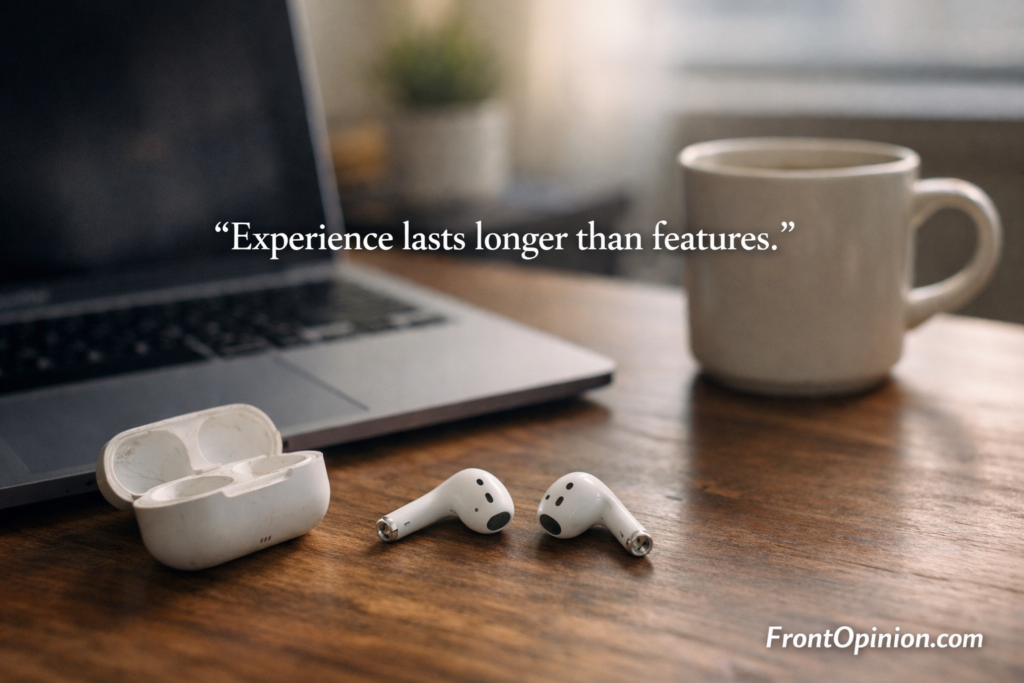
Old doesn’t automatically mean useless.
Some technology ages poorly because it relied on trends.
Other technology ages well because it was built around human behavior.
AirPods 2 fall into the second category.
They were designed before:
- Feature overload
- Gesture confusion
- Aggressive isolation culture
Instead, they focused on: AirPods 2 in 2026
- Comfort
- Simplicity
- Reliability
Those qualities don’t expire with calendar years.

Living With AirPods 2 in 2026 — Day to Day
Let me describe a normal weekday.
I open the case.
They connect instantly.
No app. No delay. No “re-pairing.”
I take calls while walking.
I listen to podcasts while working.
I pause music to talk to someone nearby — without pulling anything out.
This might sound boring.
But boring is exactly what you want from daily-use tech.
In a world full of smart devices demanding attention, AirPods 2 quietly stay out of the way.
And that’s their superpower.
The Psychological Pressure to Upgrade
There’s also something deeper happening.
Using AirPods 2 in 2026 feels wrong because tech culture has shifted from utility to identity.
Upgrading isn’t just about better sound anymore.
It’s about:
- Keeping up
- Feeling current
- Avoiding the fear of “missing out”
But here’s the uncomfortable realization:
Most upgrades don’t change your daily experience as much as your brain expects them to.
The promise is emotional.
The improvement is incremental.
Once you recognize that gap, resisting upgrades becomes easier — and surprisingly freeing.
What AirPods 2 Still Do Perfectly
When people hear AirPods 2 in 2026, the first reaction is usually disbelief.
“But they don’t even have ANC.”
“Aren’t they outdated?”
“Why not just upgrade?”
Those reactions come from spec thinking, not usage thinking.
Because when you actually live with AirPods 2 day after day, something becomes very clear:
👉 They still do the important things exceptionally well.
Not flashy things.
Not spec-sheet things.
But daily-life things — the ones that decide whether a product stays in your pocket or ends up forgotten in a drawer.
Let’s break this down honestly.
1. Effortless Connectivity: The Invisible Advantage
The biggest strength of AirPods 2 in 2026 isn’t sound.
It’s effortlessness.
Zero-friction pairing
Open the case → they connect.
No buttons.
No modes.
No hesitation.
Even in 2026, many earbuds still:
- Struggle with device switching
- Disconnect randomly
- Need app-level fixes
AirPods 2 don’t.
They behave like they understand you.
Multi-device life still feels magical
Switching between:
- iPhone → MacBook
- MacBook → iPad
…still feels instant.
This matters more than people admit.
Because when earbuds just work, your brain doesn’t have to think about them. And that’s rare.
2. Comfort That Doesn’t Demand Attention
Here’s a truth that only long-term users understand:
Comfort beats sound after the first week.
And this is where AirPods 2 in 2026 quietly dominate.
No pressure, no seal, no fatigue
Unlike in-ear ANC buds:
- There’s no “plugged” feeling
- No suction fatigue
- No ear canal soreness after hours
You can wear them:
- During full workdays
- On long calls
- While walking or sitting casually
Eventually, you forget they’re even there.
That’s not a small thing.
That’s design maturity.
Why this matters more in 2026
As work-from-home and hybrid work increased, earbuds stopped being accessories and became companions.
And companions shouldn’t irritate you.
AirPods 2 feel less like tech — and more like a habit.
3. Controls That Respect Simplicity
In a world where earbuds: AirPods 2 in 2026
- Tap
- Swipe
- Long-press
- Double-gesture
…AirPods 2 quietly said:
“What if we just don’t overdo this?”
Physical logic over gesture overload
Double-tap to play/pause or answer calls.
That’s it.
No accidental volume changes.
No unintended command triggers.
No learning curve.
This is especially valuable during:
- Meetings
- Calls
- Walking
You don’t have to think before interacting.
And thinking less is underrated tech luxury.
4. Call Experience That Still Feels Professional
One of the most surprising things about AirPods 2 in 2026 is how well they still handle calls.
Office calls
In quiet or moderately noisy environments:
- Voice sounds natural
- No robotic compression
- Minimal echo complaints
People rarely ask:
“Can you repeat that?”
That alone makes them usable for professional life.
Why this matters more than music
Most people use earbuds more for:
- Calls
- Meetings
- Voice notes
…than for immersive music sessions.
AirPods 2 were tuned with human voice priority — and that tuning has aged incredibly well.
5. Lightweight Design = Everyday Freedom
Specs don’t show this, but your ears feel it.
AirPods 2 are:
- Extremely light
- Balanced
- Non-intrusive
This makes them ideal for: AirPods 2 in 2026
- Walking
- Light workouts
- Long listening sessions
Heavier earbuds may sound better — but they constantly remind you they’re there.
AirPods 2 don’t.
6. Reliability Over Time
Here’s something most reviews don’t revisit after launch:
Consistency after years.
In my long-term use:
- No sudden connection bugs
- No app dependency failures
- No firmware surprises
In 2026, that stability is rare.
Many newer earbuds become temperamental over time.
AirPods 2 have remained predictable.
And predictability is comfort.
7. The “Enough” Factor
This is the core idea behind continuing to use AirPods 2 in 2026.
They hit the “enough” threshold in every daily category:
- Comfort ✅
- Calls ✅
- Connectivity ✅
- Ease of use ✅
Once a product reaches “enough,” upgrades stop feeling urgent.
They become optional.
And optional upgrades are easier to skip.
Real-World Analogy
Using AirPods 2 in 2026 is like:
- Driving a well-maintained car that starts every morning
- Using a keyboard you type fastest on
- Wearing shoes that fit perfectly but aren’t trendy
Could you replace them?
Yes.
Would it meaningfully change your daily life?
Not really.
What This Means Going Forward
At this point, AirPods 2 are no longer competing with new earbuds.
They’re competing with habit.
And habit is incredibly hard to beat.
Sound Reality After Years of Use
When people ask about AirPods 2 in 2026, this is the question hiding behind everything else:
“But… how do they sound now?”
Not how did they sound at launch.
Not how do they compare on paper.
But how do they sound after years of real use — batteries aged, drivers worn in, expectations matured.
So let’s answer it honestly.
First, Let’s Kill the Myth
No — AirPods 2 in 2026 do not sound amazing.
They don’t feel immersive.
They won’t impress audiophiles.
They don’t shake your head with bass.
But here’s the more important truth:
👉 They still sound right.
And “right” matters more than “wow” in everyday life.
What the Sound Is Actually Like
After years of use, the sound profile of AirPods 2 has remained surprisingly stable.
1. Vocals: Still the Strongest Point
Human voices sound:
- Clear
- Natural
- Forward
This is why podcasts, audiobooks, and calls still feel effortless.
You don’t strain.
You don’t adjust volume constantly.
You don’t feel ear fatigue.
For spoken content, AirPods 2 in 2026 are still excellent.
2. Music: Honest, Not Emotional
Music playback is where expectations need calibration.
What you get:
- Clean mids
- Controlled highs
- Light bass
What you don’t get: AirPods 2 in 2026
- Depth
- Punch
- Soundstage
Think of it like listening to music on a well-tuned car stereo — not a concert system.
You enjoy the song.
You understand the lyrics.
You don’t feel the song.
And for many daily scenarios, that’s perfectly fine.
Sound Degradation: Has It Happened?
This is important for a long-term review.
The surprising answer: very little
Unlike battery health, sound quality doesn’t degrade dramatically over time unless there’s physical damage.
In my experience:
- No distortion creep
- No imbalance between left/right
- No crackling at normal volumes
The drivers have aged gracefully.
Which means if your AirPods 2 sounded “okay” on day one, they still sound okay in 2026.
Why Lack of ANC Changes Sound Perception
Here’s something most reviews miss.
Sound quality isn’t just about speakers — it’s about environment.
Without ANC:
- Background noise mixes with audio
- Bass feels lighter
- Immersion drops
But something else improves.
You don’t crank volume to escape noise.
This keeps listening levels healthier and more comfortable over long sessions.
Ironically, AirPods 2 in 2026 encourage safer listening habits than some ANC earbuds.
Where AirPods 2 Sound Their Best
Let’s be specific.
They sound best when:
- Indoors
- In quiet environments
- At moderate volume
Perfect for:
- Office desks
- Home listening
- Night-time use
They’re not designed for:
- Loud gyms
- Flights
- Crowded transport
And that’s okay — as long as expectations match reality.
Comparison Reality
People love comparing AirPods 2 vs Pro.
Here’s the grounded version:
- AirPods Pro: immersive, controlled, modern
- AirPods 2: clear, light, unobtrusive
One pulls you into the sound.
The other lets sound exist around you.
Neither is “wrong.”
They just serve different mental states.
Why Sound “Enough” Beats Sound “Better”
After years of use, I realized something unexpected.
I don’t listen to sound quality anymore.
I listen through it.
If audio lets me:
- Focus
- Understand
- Stay comfortable
…it’s doing its job.
And AirPods 2 in 2026 still pass that test.
Better sound would be nice.
But better comfort and mental ease matter more — and those remain intact.
A Simple Analogy
Using AirPods 2 for sound in 2026 is like:
- Drinking clean water instead of flavored drinks
- Using a neutral keyboard instead of a mechanical one
- Wearing glasses that correct vision without style statements
Nothing flashy.
Nothing dramatic.
Just clarity.
The Hidden Advantage of Familiar Sound
There’s also something psychological here.
Your brain adapts to a sound signature over time.
Once adapted:
- Minor flaws disappear
- Comfort increases
- Listening becomes effortless
Switching to new earbuds often feels “better” for a week — then just different.
With AirPods 2 in 2026, familiarity has become a feature.
Call Quality in Office & Travel + Battery Degradation
If sound quality decides enjoyment, then calls and battery decide survival.
You can forgive average music.
You cannot forgive:
- People asking “Hello? Can you hear me?”
- Earbuds dying mid-meeting
So in this part, let’s talk about the two most practical questions around AirPods 2 in 2026 — with zero marketing gloss.
Call Quality in Office & Work-from-Home
This is where AirPods 2 quietly justify their continued existence.
Office calls: Surprisingly professional
In quiet or semi-quiet spaces, call quality is still:
- Clear
- Natural
- Stable
Your voice doesn’t sound robotic.
It doesn’t feel compressed or metallic.
Most colleagues don’t even realize you’re using old earbuds — and that’s the point.
Why AirPods 2 still work for calls
They were tuned in an era when:
- Voice mattered more than immersion
- Calls mattered more than music
The microphones prioritize:
- Speech clarity
- Consistent volume
- Natural tone
That tuning has aged better than many feature-heavy alternatives.
Calls While Walking or Commuting
Let’s be realistic.
AirPods 2 in 2026 are not magic in noisy environments — but they’re usable.
On streets and light traffic
- Voice remains understandable
- Wind handling is decent
- Occasional background noise leaks in
But here’s the key difference:
Your voice stays human.
Some modern earbuds over-process noise and make you sound artificial. AirPods 2 let a bit of the world in — and that actually helps clarity.
Travel Calls: The Honest Truth
This is where limitations show up.
In trains, buses, airports
- Background noise is audible
- You’ll need to speak slightly louder
- ANC would help here
If your work involves:
- Frequent airport calls
- Loud travel conversations
Then yes — AirPods 2 in 2026 may feel limiting.
But for occasional travel calls?
They’re still manageable.
Battery Degradation: No Sugarcoating
Now let’s talk about the real aging factor.
Current real-world battery numbers
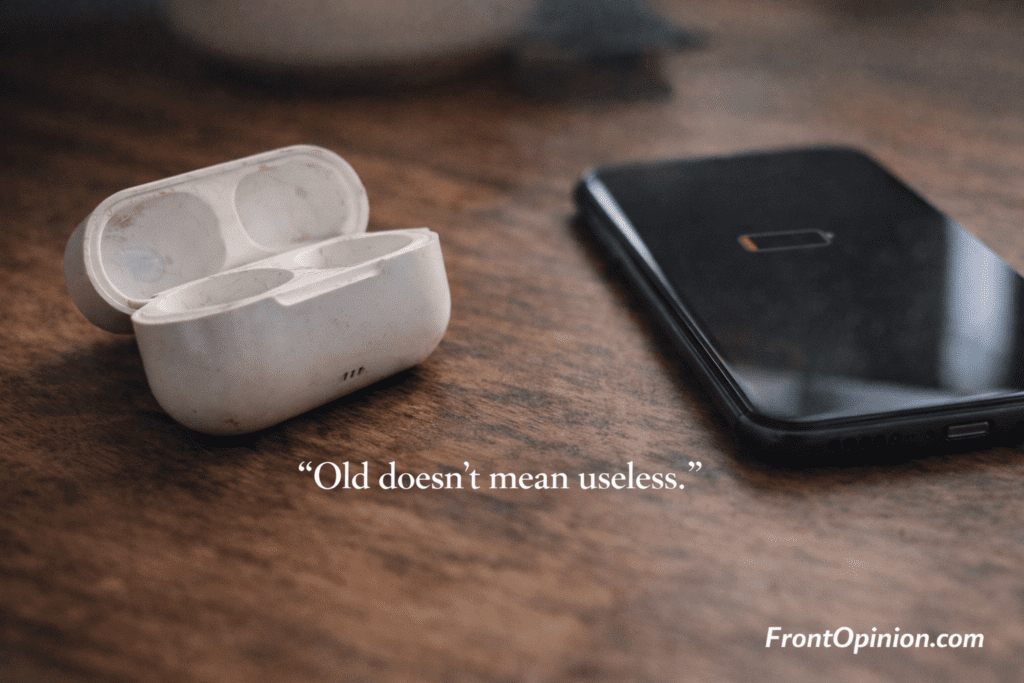
After years of use, my AirPods 2 deliver roughly:
- 2.5 to 3 hours per charge
- Case provides 2–3 additional charges
- Total daily use: 7–8 hours with breaks
This is clearly lower than new models.
But context matters.
Why Battery Still Works in Daily Life
Most people don’t use earbuds continuously.
Instead, usage looks like:
- 30–60 minute calls
- Short listening sessions
- Frequent case top-ups
AirPods 2 still support this pattern perfectly.
The underrated fast top-up
10–15 minutes in the case =
Enough battery for another meeting or commute.
This single habit makes battery aging far less painful than specs suggest.
The Psychological Difference Between “Short” and “Predictable”
Here’s something important.
A short battery that behaves predictably is better than a long battery that surprises you.
With AirPods 2 in 2026, I know:
- When to charge
- How long I’ll get
- What to expect
That predictability builds trust.
And trust keeps you from upgrading impulsively.
Battery vs Upgrade Pressure
Many people upgrade not because battery is unusable — but because it feels old.
That’s a psychological trigger, not a functional one.
If your routine includes:
- Access to charging
- Natural breaks
- Desk work
Then AirPods 2 battery life is still serviceable in 2026.
Real-Life Scenario
Imagine this workday:
- Morning calls (1.5 hours)
- Break → case charge
- Afternoon meetings (1.5 hours)
- Evening walk + podcast
This is exactly where AirPods 2 in 2026 still fit effortlessly.
Life Without ANC — The Mental Impact + Why Upgrading Still Feels Unnecessary
This is the part most reviews never talk about.
Not sound.
Not battery.
Not features.
But how AirPods 2 in 2026 make you feel.
Because after years of daily use, the biggest reason I still haven’t upgraded isn’t technical at all — it’s psychological.
Life Without ANC: What You Gain by Not Blocking the World
Active Noise Cancellation is powerful.
There’s no denying that.
But living without it changes your relationship with sound — and with your surroundings.
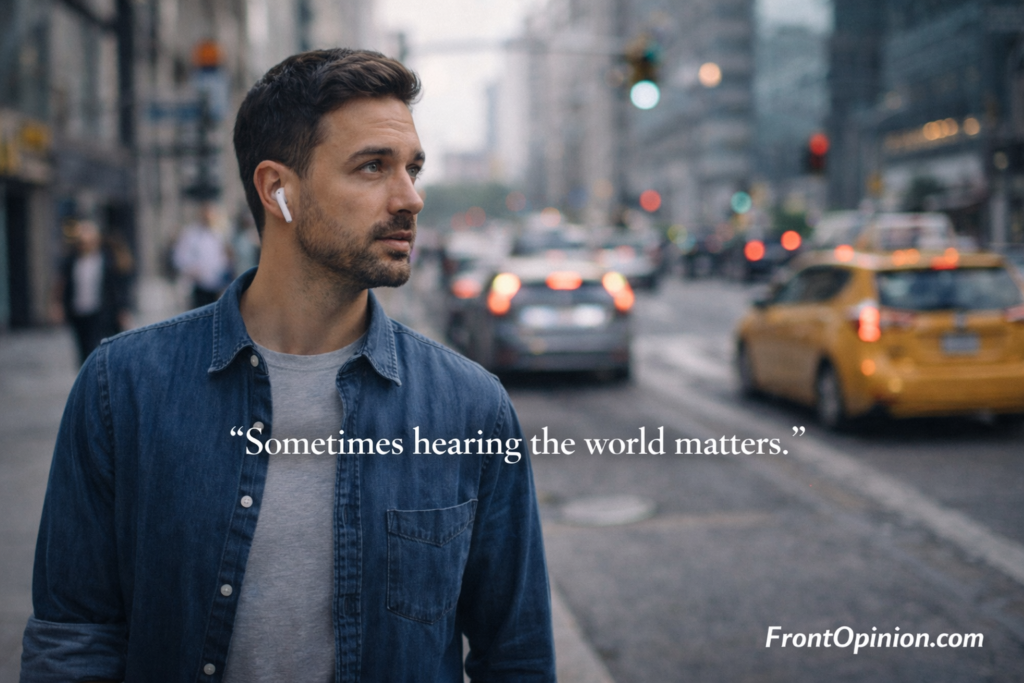
Awareness becomes natural again
Using AirPods 2 in 2026, I can:
- Hear someone calling my name
- Notice traffic while walking
- Catch office cues without removing earbuds
This creates a subtle but important mental comfort.
You’re not sealed off.
You’re not startled when someone speaks.
You’re still present.
ANC vs Awareness: A Trade Most People Don’t Notice
ANC is fantastic for:
- Flights
- Trains
- Loud environments
But in daily life, it comes with side effects:
- Increased isolation
- Sudden silence fatigue
- Disconnection from surroundings
With AirPods 2, sound blends instead of replaces reality.
It’s like listening to background music in a café instead of wearing earplugs with speakers.
That balance feels healthier over long periods.
Mental Fatigue Is a Real Thing
After hours of ANC use, many people experience:
- Pressure fatigue
- Mild disorientation
- A strange “coming back” feeling when removing earbuds
With AirPods 2 in 2026, that never happens.
There’s no artificial silence to recover from.
No pressure to release.
Just take them out — and life continues normally.
Why This Matters More in 2026
In 2026, earbuds aren’t occasional accessories.
They’re worn:
- All workday
- During commutes
- On walks
- While doing chores
That’s a lot of time inside your own head.
And sometimes, less isolation = better mental balance.
The Unexpected Benefit: Lower Listening Volume
Here’s something surprising.
Because AirPods 2 don’t cancel noise, you:
- Don’t chase silence
- Don’t crank volume aggressively
Your ears adapt to moderate listening levels.
Over time, this becomes:
- More comfortable
- Less tiring
- Healthier for hearing
ANC earbuds often tempt users to push volume higher to maximize immersion.
AirPods 2 quietly discourage that habit.
Why Upgrading Still Feels Unnecessary
Now let’s connect everything so far.
When you consider:
- Comfort
- Call quality
- Sound clarity
- Mental ease
- Predictability
You realize something uncomfortable for marketers:
AirPods 2 already solve the problem they were bought for.
Upgrading doesn’t solve a problem.
It adds features.
And features don’t always equal value.
The “Upgrade Pressure” Trap
Most upgrades happen because of:
- FOMO
- Comparisons
- Influencer framing
Not because something stopped working.
In my case, AirPods 2 in 2026 still:
- Turn on instantly
- Connect reliably
- Fit comfortably
- Handle my daily needs
So upgrading would be an emotional purchase — not a rational one.
The Cost vs Benefit Reality
Upgrading means:
- Spending significant money
- Adjusting to new controls
- Accepting different comfort
What do I gain?
- ANC (situational benefit)
- Slightly better sound
- Newness
What do I lose?
- Familiarity
- Comfort certainty
- Mental simplicity
That trade doesn’t feel obvious anymore.
The “Enough” Line (This Is Key)
There’s a moment when technology crosses from:
“I need this to work”
to
“This works well enough”
AirPods 2 crossed that line years ago — and never fell back.
Once you reach “enough,” upgrading becomes optional, not urgent.
And optional upgrades are easy to delay.
A Very Real Thought I Had
At some point, I stopped thinking:
“When should I upgrade?”
And started thinking:
“Why should I upgrade?”
That shift changes everything.
And it’s why AirPods 2 in 2026 still live in my pocket.
Who Should Buy, Who Should Avoid
This is the part where everything we’ve discussed about AirPods 2 in 2026 turns into a clear decision.
No philosophy.
No emotions.
Just honest fit.
Because the truth is simple:
👉 AirPods 2 are not for everyone in 2026 — but for the right people, they still make perfect sense.
Who Should Still Buy AirPods 2 in 2026
You should seriously consider AirPods 2 in 2026 if you fall into any of these categories:
1. Office professionals & remote workers
If your day is filled with:
- Calls
- Meetings
- Voice communication
AirPods 2 still deliver:
- Natural voice clarity
- Reliable connectivity
- Zero distraction controls
They behave like professional tools, not toys.
2. Podcast & audiobook listeners
If most of your listening is:
- Podcasts
- Audiobooks
- YouTube videos
Then AirPods 2 are still excellent.
Clear vocals matter more than bass or soundstage — and this is where they shine even in 2026.
3. Comfort-first users
If you’ve ever felt:
- Ear fatigue from in-ear buds
- Pressure from sealed tips
- Discomfort after long use
AirPods 2 will feel like relief.
They’re ideal for:
- Long workdays
- Casual listening
- People sensitive to in-ear pressure
4. Minimalists & “it just works” users
If you value:
- Simplicity
- Predictability
- Zero learning curve
AirPods 2 still fit beautifully into a minimalist tech lifestyle.
No app dependency.
No feature anxiety.
No constant tweaking.
5. Budget-conscious Apple users
If you want Apple ecosystem benefits without paying premium prices, AirPods 2 still offer strong value when priced right.
Especially as:
- Secondary earbuds
- Work-only earbuds
- Backup travel pair
Who Should Absolutely Avoid AirPods 2 in 2026
Now the honest warnings.
You should not buy AirPods 2 in 2026 if:
1. You need Active Noise Cancellation
If you:
- Travel frequently by air
- Work in noisy environments
- Need silence to focus
ANC is not optional for you — it’s essential.
AirPods 2 will frustrate you.
2. You’re a music-first listener
If music is your primary use and you care about:
- Bass depth
- Immersion
- Soundstage
AirPods 2 will feel flat.
They’re tuned for clarity, not excitement.
3. You want long, uninterrupted battery life
If you expect:
- 6–8 hours continuous playback
- Full-day use without charging
AirPods 2 won’t meet that expectation in 2026.
Battery aging is real.
4. You upgrade for features, not function
If new features excite you more than daily comfort, AirPods 2 will feel outdated.
They’re not meant to impress — they’re meant to disappear.
Pros & Cons Snapshot
✅ Pros
- Still seamless in Apple ecosystem
- Extremely comfortable for long use
- Excellent call clarity
- Lightweight and reliable
- Simple, distraction-free controls
❌ Cons
- No Active Noise Cancellation
- Aging battery life
- Average music immersion
- Limited features by 2026 standards
Frequently Asked Questions
Q1. Are AirPods 2 worth buying in 2026?
Yes — if your priority is calls, comfort, and simplicity, not immersive sound or ANC.
Q2. How long does AirPods 2 battery last in 2026?
On average, 2.5–3 hours per charge, with multiple recharges from the case.
Q3. AirPods 2 vs AirPods Pro — which should I choose?
Choose AirPods Pro for ANC and immersion.
Choose AirPods 2 for comfort, calls, and ease of use.
Q4. Are AirPods 2 still good for office work?
Absolutely. They remain one of the most reliable earbuds for meetings and calls.
Q5. Is it smart to upgrade from AirPods 2?
Only if ANC, better music quality, or longer battery life solves a real problem for you.
Conclusion: When “Enough” Beats “New”
Using AirPods 2 in 2026 taught me something important about technology.
Progress doesn’t always mean improvement.
Sometimes, it just means more.
More features.
More complexity.
More reasons to upgrade.
But AirPods 2 reached a rare place — enough.
They’re comfortable enough.
Clear enough.
Reliable enough.
Simple enough.
And once a product reaches “enough,” upgrading becomes optional — not necessary.
That’s why I’m still using them.
And that’s why many people quietly should too.